
Tank vs Tankless Water Heater – Phoenix Guide

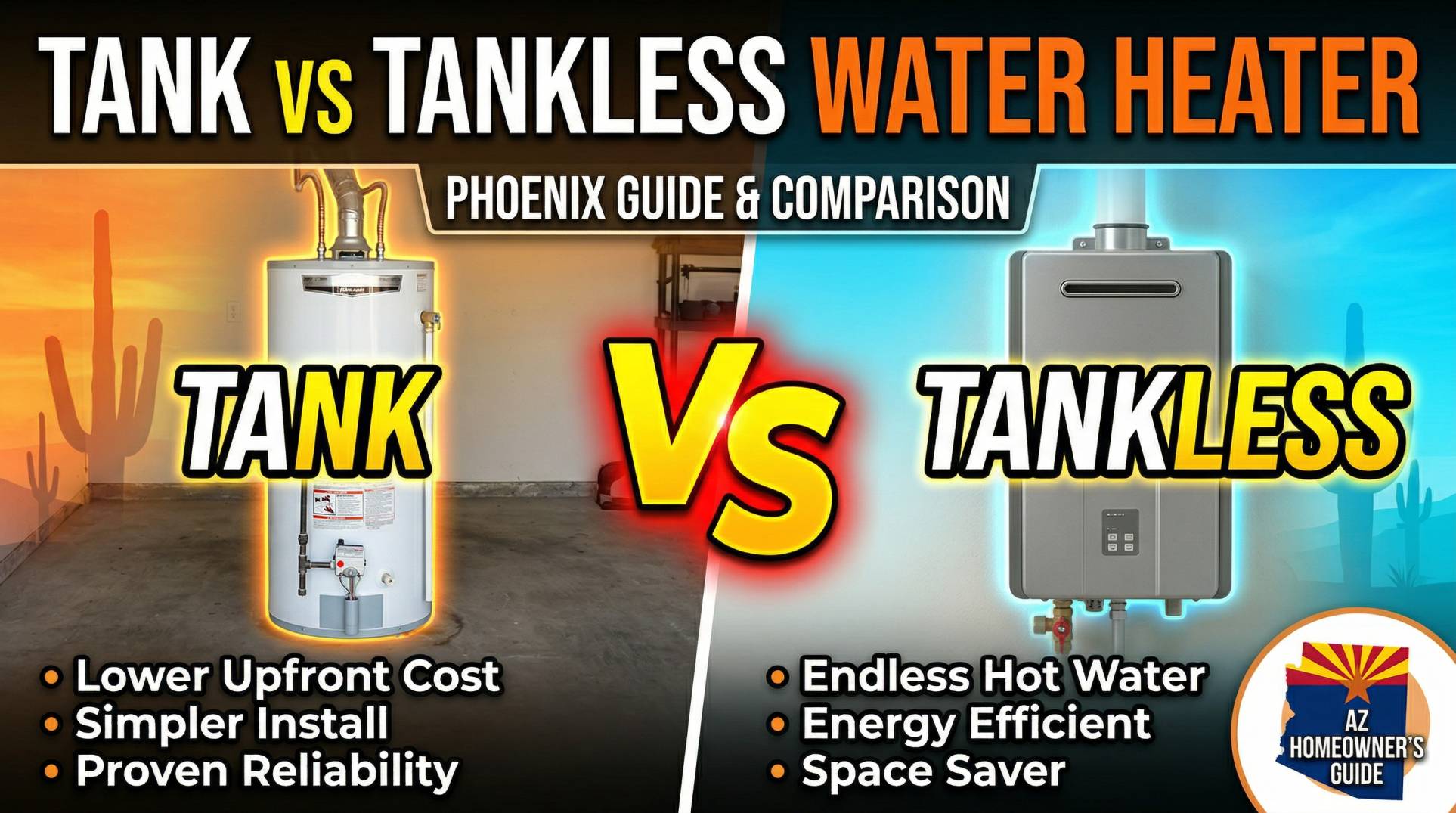
Choosing between a tank or tankless water heater can save Phoenix homeowners time, money, and hassle in our demanding climate. This guide breaks down key differences, local challenges like hard water, and practical steps to pick the right system for your home.
How Tank Water Heaters Work
Tank water heaters store 30 to 80 gallons of water in an insulated tank, keeping it heated around the clock using gas or electricity. They recover by reheating water after use, typically at 40-50 gallons per hour for standard models. In Phoenix homes, these units sit in garages or utility rooms, handling daily demands from showers to dishwashing.
This design suits families with steady hot water needs but leads to standby energy loss as the tank maintains heat even when idle. Expect a lifespan of 10-15 years here due to mineral buildup from our hard water.
How Tankless Water Heaters Work
Tankless units, or on-demand heaters, heat water directly as it flows through the device, without storing any. Gas or electric models activate only during use, delivering endless hot water at flow rates of 3.5-7 gallons per minute based on household size. Wall-mounted and compact, they fit tight spaces like closets.
In Arizona’s warm weather, they perform well with minimal temperature rise needed—often 40-60°F—making sizing straightforward for most homes. Lifespans reach 20 years or more with maintenance.
Key Differences in Performance
Tank heaters provide immediate hot water from storage but risk running cold during peak use, like back-to-back showers. Tankless avoids this with continuous supply, ideal for larger Phoenix families.
Efficiency favors tankless by up to 34%, cutting standby losses absent in tanks. Both handle gas or electric, but gas versions recover faster in our climate. Flow rates matter: tanks suit 1-2 simultaneous fixtures; tankless manages 3-4.
| Feature | Tank Water Heater | Tankless Water Heater |
|---|---|---|
| Hot Water Supply | Limited by tank size (30-80 gal) | Endless on-demand |
| Efficiency | 0.5-0.7 EF, standby losses | 0.8-0.99 EF, no standby |
| Space Needed | Large footprint (4×2 ft) | Compact wall-mount (2×1 ft) |
| Recovery Rate | 40-50 gal/hour | 3.5-7 gal/min |
| Best For | Small households, budget installs | High-demand homes, efficiency |
Pros and Cons for Phoenix Homes
Tank Pros: Lower upfront costs ($900-$1,500 install), simple setup, familiar tech. They work during outages if gas-powered.
Tank Cons: Higher energy bills from constant heating, sediment clogs efficiency fast in hard water, shorter life.
Tankless Pros: Saves 24-40% on bills, space-efficient, long-lasting. Endless water prevents “cold shower” mornings.
Tankless Cons: Higher install ($2,000-$4,500), needs gas line/electrical upgrades, annual descaling.
Phoenix’s hard water accelerates tank sediment but affects tankless scale buildup too—both need flushing.
Costs: Installation and Long-Term Savings
Tank installs average $1,200 in Phoenix, including permits. Tankless runs $2,800-$3,700, plus venting/gas upgrades.
Operating costs: tanks use more energy; tankless pays back in 5-10 years via efficiency. SRP rebates up to $1,750 for heat pump models (tank-style hybrids). Factor hard water softeners ($500-$2,000) for longevity.
Annual maintenance: $100-200 for tanks (flush); $150-300 for tankless (descaling).
| Cost Type | Tank Average | Tankless Average |
|---|---|---|
| Unit + Install | $900-$1,500 | $2,000-$4,500 |
| Monthly Energy (family of 4) | $20-30 | $15-22 |
| Lifespan Savings | Replace every 12 yrs | Replace every 20 yrs |
| Maintenance/Year | $100 flush | $200 descale |
Phoenix-Specific Challenges and Solutions
Hard water in Phoenix (high calcium/magnesium) causes rumbling noises, low efficiency, and early failure in tanks. Solution: Annual flushing removes sediment—turn off power, drain via hose, refill.
Tankless faces scale on heat exchangers; descale yearly with vinegar or pro service. Our 100°F+ groundwater means less heating strain, boosting tankless appeal.
Leaky tanks flood garages; tankless rarely leaks. Permits required ($50-100); pros handle code.
Quick Fix Tips:
-
Test temperature (120°F ideal).
-
Insulate pipes to cut wait times.
-
Install water softener for both types.
Maintenance Tips to Extend Lifespan
Flush tanks yearly: Connect garden hose to drain valve, run to floor drain, empty fully. Check anode rod every 3 years (replace if corroded).
For tankless: Descale per manufacturer (every 6-12 months here). Inspect vents, filters.
Signs of trouble: No hot water, leaks, odd noises—call pros early. In Phoenix, pros prevent bigger issues like bursts.
Sizing Guide for Your Household
Match to peak use. Tanks: 40-gal for 2-4 people; 50-gal for 5+.
Tankless: 3.5 GPM (1-2 fixtures); 5 GPM (2-3); 7 GPM (3-4). Calculate: Add fixture flows (shower 2 GPM, sink 1.5).
Phoenix example: Family of 4, 2 baths—5 GPM tankless or 50-gal tank.
When to Choose Tank vs Tankless
Pick tank if: Budget-tight, small home, low usage.
Go tankless if: Endless water needed, remodel for efficiency, long-term home.
Hybrids (heat pump tanks) shine in garages for extra savings.
Common Problems and Fixes
Tank Issues: Sediment (flush), thermostat fail (replace $200), leaks (new tank).
Tankless Issues: Scale (descaling), flow sensor (clean $150), cold bursts (size up).
Phoenix hard water worsens both—softener prevents 80% problems.
DIY first: Reset breaker, check pilot. Pros diagnose rest.
Energy Efficiency and Rebates
Tankless cuts waste; tanks lose 10-20% standby. Gas cheaper per BTU here.
Rebates: Efficiency Arizona up to $1,750 heat pumps; solar options $2,000 max. Check SRP for 2026.
Making the Switch: Installation Steps
-
Assess needs/sizing.
-
Get quotes, permits.
-
Shut off utilities, remove old.
-
Install new, test.
-
Flush/softener add-on.
Pros ensure code compliance, warranties.
For reliable tank or tankless installs in Phoenix, contact Emergency Master Plumbing & Air at 623-584-4706. Our team handles repairs, replacements, and maintenance fast, tailored to local water challenges.