Scottsdale Tankless Water Heater Installation: Pros & Cons

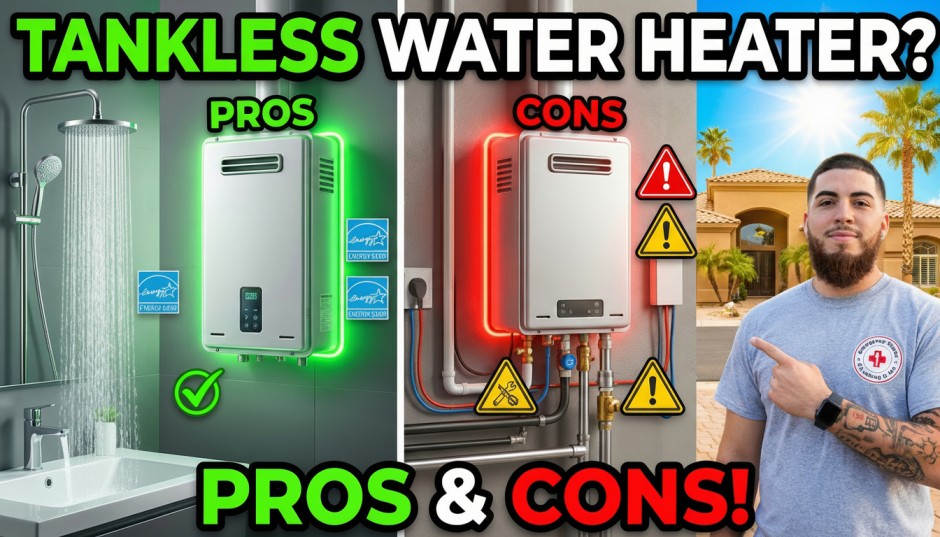
Tankless water heaters heat water only when you turn on a tap, delivering hot water on demand instead of storing it in a tank, which reduces standby energy loss compared to traditional storage units. Many homeowners also choose them for the compact, wall-mounted design and the ability to enjoy continuous hot water within the unit’s flow capacity.
Key advantages
- Higher efficiency because the unit avoids heating a full tank 24/7, reducing wasted energy from standby losses.
- Continuous hot water for back-to-back showers and daily routines, as long as your unit’s flow rating isn’t exceeded.
- Space-saving, wall-mounted footprint that frees up floor area in garages, closets, or utility rooms.
- Longer service life potential versus many storage-tank models when installed correctly and maintained on schedule.
Important trade-offs
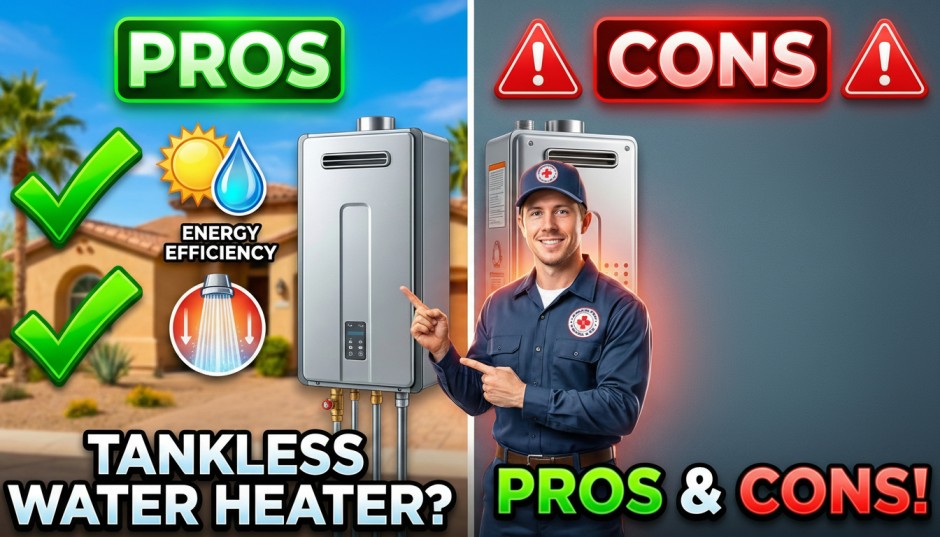
- Higher upfront cost for equipment and install, and you may need gas line or electrical panel upgrades to meet demand.
- Limited simultaneous usage; if multiple fixtures run at once, you can exceed the unit’s flow capacity and see temperature drop.
- Gas models require proper venting and combustion air; electric models often need dedicated high-amperage circuits.
Quick comparison for Scottsdale homes
| Factor | Tankless | Storage tank |
| Hot water supply | On-demand and continuous within the unit’s rated flow; no standby tank to deplete | Finite volume; can run out during heavy use and requires recovery time |
| Energy use | Reduces standby losses by heating only when needed | Ongoing standby losses to keep the tank hot |
| Upfront cost | Higher; installation can involve gas/electric upgrades | Generally lower equipment and install cost |
| Space | Compact, wall-mounted design | Bulky footprint due to large tank |
| Lifespan | Often 15–20 years with proper maintenance | Commonly around 10 years for many models |
| Multi-fixture use | Can hit flow limits with many fixtures at once | Can supply multiple fixtures until tank is depleted |
Sizing made simple
Picking the right size comes down to two essentials: how many hot-water fixtures you expect to run at once and the temperature rise needed from incoming water to your preferred outlet temperature. Add up the expected simultaneous demand and match it to a unit whose flow rating can keep that many fixtures comfortable at your chosen temperature. If your household frequently runs showers, laundry, and dishwashing together, consider a higher-capacity whole-home unit or strategically placed point-of-use units to serve separate zones.
Installation checklist
- Confirm gas or electrical capacity: tankless units can require larger gas lines or dedicated electric circuits; plan upgrades if needed.
- Venting and combustion air: gas models must be vented per code, using approved materials and routing; ensure safe termination clearances.
- Location and clearances: mount on a suitable wall with manufacturer-recommended clearances for service access and airflow.
- Water quality management: install isolation valves for annual flushing; consider scale mitigation in hard-water areas to protect the heat exchanger.
- Condensate handling (for condensing gas models): route to a drain with a neutralizer if required by the manufacturer and local code.
- Permits and inspection: follow local code requirements and schedule inspection to verify safe, compliant operation.
Operating tips to avoid cold surprises
- Know your unit’s flow rating and prioritize fixtures during peak times to stay within its capacity ceiling.
- Set a safe outlet temperature and let the unit do the mixing; modern controls help maintain consistent delivery.
- When demand spikes are routine, consider staggering usage or adding a second unit/point-of-use device for remote bathrooms or casitas.
Maintenance that pays off
- Annual descaling/flush: use the isolation valves to circulate a descaling solution and remove mineral buildup; this helps maintain efficiency and longevity.
- Inlet screens and filters: clean per the manual to prevent flow restrictions that can trigger temperature fluctuations.
- Venting and condensate: inspect for obstructions, corrosion, or leaks, and verify proper drainage on condensing systems.
Is a tankless upgrade right for you?
Choose tankless if you value space savings, lower standby energy use, and the convenience of continuous hot water within the unit’s flow rating. A conventional tank may be better if your home often runs multiple hot-water fixtures simultaneously and you prefer lower initial costs without upgrading gas lines or electrical service.
What to ask your installer
- Capacity and temperature rise: Which model meets your simultaneous-use pattern without hitting flow limits?
- Fuel and infrastructure: Will the install require upsizing gas lines, adding venting, or upgrading the electrical panel and breakers?
- Maintenance plan: What’s the recommended flushing interval and scale mitigation strategy to protect the heat exchanger?
- Code and permits: Who pulls the permit, schedules inspection, and documents compliance?
Final recommendation for Scottsdale homeowners
A properly sized, professionally installed tankless system can reduce standby energy waste and free up valuable space while providing continuous hot water within the unit’s capacity. If your home demands frequent multi-fixture use, plan for a higher-capacity unit, strategic fixture scheduling, or supplemental point-of-use heaters to avoid flow-induced temperature dips.
Talk to Emergency Master Plumbing & Air
Ready to upgrade, size, or troubleshoot a tankless system in Scottsdale? Call Emergency Master Plumbing & Air at 623-584-4706 for code-compliant installation, conversion, or maintenance tailored to your home and usage. Our licensed team will assess your fixture-by-fixture demand, verify gas/electric capacity, and set up a maintenance plan so you enjoy reliable, efficient hot water year-round.